
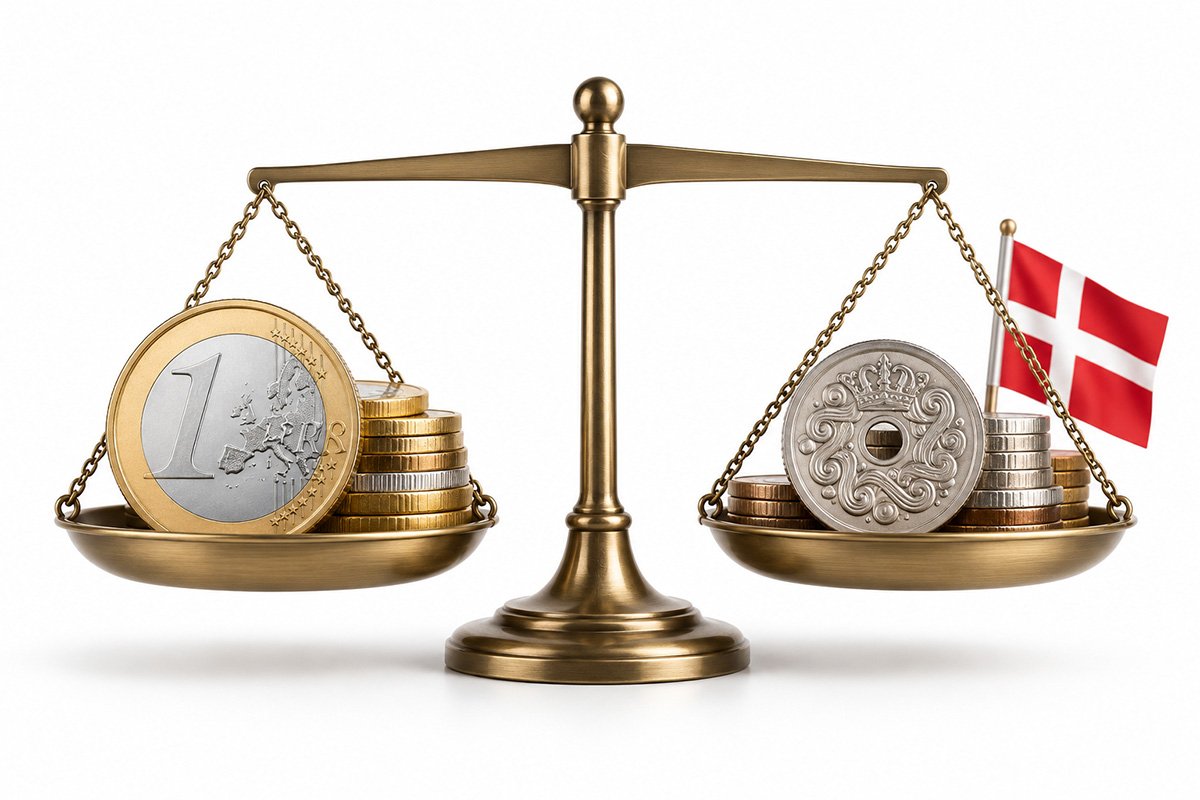
If you follow exchange rates, you may have noticed something odd. The dollar can rise and fall significantly. The same goes for the British pound, the Swedish krona and the Norwegian krone. But the euro moves only very little against the Danish krone.
That is no coincidence.
Denmark operates a fixed exchange rate policy against the euro. The goal is to keep the value of the Danish krone stable, and this is one of the main reasons why EUR/DKK looks completely different from most other currency pairs.
Why is the euro exchange rate so stable?
The official central rate between the Danish krone and the euro is:
1 EUR = 7.46038 DKK
Or, as exchange rates are often quoted in Denmark:
100 EUR = 746.038 DKK
The central rate acts as the level the Danish krone is kept around.
The actual market rate is not necessarily exactly the same every day. It may be slightly higher or lower depending on supply and demand for kroner and euros.
The key point is that the fluctuations are usually very small compared with, for example, EUR/USD, EUR/SEK or EUR/NOK.
Denmark has pursued a fixed exchange rate policy since the 1980s
Denmark’s current exchange rate policy has its roots in the early 1980s.
Back then, the krone was stabilised against the German D-mark. When the euro was introduced, the Danish krone was instead pegged to the euro.
Since 1999, Denmark has participated in the European exchange rate cooperation ERM II.
This does not mean that Denmark uses the euro. We still have our own currency and our own central bank. But the value of the krone is actively kept close to the euro.
That is why the euro rate can look almost locked in on a chart, while other currencies move much more.
What is ERM II?
ERM II stands for Exchange Rate Mechanism II and is an exchange rate arrangement between the euro area and EU countries outside the euro.
Denmark’s central rate is 7.46038 kroner per euro.
The standard ERM II system allows relatively large fluctuations around a central rate, but Denmark has a special agreement with a much narrower band of ±2.25 percent.
This means that, formally, the euro can move between approximately:
7.2925 DKK and 7.6282 DKK per euro.
In practice, however, the krone is usually kept much closer to the central rate than these outer limits.
This is an important difference. The limits tell you how far the rate is allowed to move within the agreement. They do not tell you where Danmarks Nationalbank will normally accept the rate to be.
How does Danmarks Nationalbank keep the krone stable?
The exchange rate is still determined in the FX market. If many investors want to buy Danish kroner, the krone will normally strengthen. If demand falls, it may weaken.
Danmarks Nationalbank mainly has two tools to prevent the movements from becoming too large.
The first is FX intervention.
If the krone becomes too weak, Danmarks Nationalbank can buy Danish kroner and sell foreign currency. This increases demand for kroner and can strengthen the rate.
If the krone, on the other hand, becomes too strong, Danmarks Nationalbank can do the opposite: sell kroner and buy foreign currency.
The second tool is interest rates.
Higher Danish interest rates can make it more attractive to hold money in Danish kroner and thereby strengthen the krone. Lower rates can make kroner less attractive and thereby weaken it.
Danmarks Nationalbank therefore does not need to wait until the krone hits the official ERM II limits. It can react much earlier.
Why do Danish interest rates often follow the ECB?
The fixed exchange rate policy has a consequence that is not always visible when you only look at the EUR/DKK exchange rate.
Denmark cannot conduct monetary policy completely independently of the euro area.
If the European Central Bank, the ECB, changes its rates sharply while Denmark does something completely different, the difference can affect demand for Danish kroner and put pressure on the exchange rate.
That is why Danmarks Nationalbank’s rates often track the ECB’s rates relatively closely.
They do not have to be identical. Danmarks Nationalbank can maintain an interest rate spread to the ECB and adjust it if necessary to keep the krone stable.
But the most important objective of Danish monetary policy is to keep the krone’s exchange rate stable against the euro.
Why does the dollar move so much more?
The fixed exchange rate policy applies only between the Danish krone and the euro.
The krone has no fixed rate against the US dollar, British pound, Swedish krona, Norwegian krone or other currencies.
If the dollar becomes 10 percent stronger against the euro, it will therefore typically also become roughly correspondingly stronger against the Danish krone.
This creates an interesting effect: Even though Denmark has its own currency, the krone’s international value largely follows the euro’s development.
So when you see large moves in USD/DKK, GBP/DKK or JPY/DKK, they are often not due to major changes in the Danish krone itself. Instead, it is the other currency moving against the euro.
Do you get the same rate at the bank?
No.
The central rate and the exchange rate you get from a bank, card issuer or currency exchange are two different things.
If the market rate, for example, is around 7.46 kroner per euro, that does not mean you can necessarily buy one euro at exactly that rate.
Banks and payment providers may add an FX markup or a margin on top of the market rate. There may also be a separate fee.
That is why it is worth distinguishing between the official or observed exchange rate and the rate you actually get when making a payment or exchanging currency.
On eValuta.dk you can track the current EUR/DKK rate and view historical exchange rates, so you have a reference point when comparing it with the rate a bank or payment provider offers.
My view: the stable euro rate is a strength
A chart where the euro barely moves against the krone is not very dramatic. But that is exactly the point.
The fixed exchange rate policy gives Danish businesses and consumers a high degree of predictability in trade with the euro countries, which make up a large share of Denmark’s economic relationships.
The price is that Denmark at the same time gives up some of the freedom to run a fully independent monetary policy.
You can argue that Denmark should have greater scope to set interest rates based on conditions in the Danish economy. But as long as the fixed exchange rate policy is the goal, stability between the krone and the euro comes first.
What you should watch
You should therefore not expect EUR/DKK to suddenly start behaving like USD/DKK or NOK/DKK.
Small movements around the central rate are normal. The interesting part only arises if, over a longer period, the krone clearly moves in one direction, or if Danmarks Nationalbank starts intervening or changing interest rates to influence the exchange rate.
So when, year after year, the euro continues to stay close to the same level against the krone, it is not random.
It is the result of a deliberate Danish exchange rate policy that has been pursued for decades.