
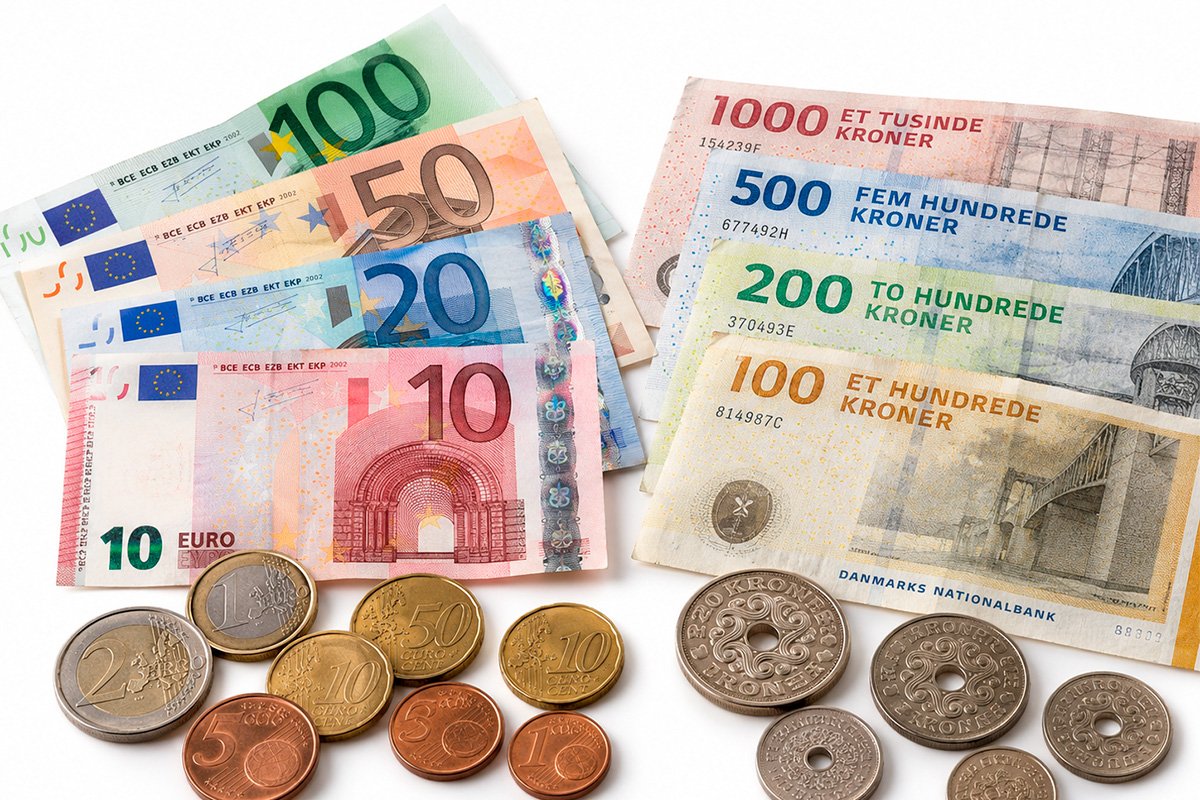
There are two EUR/DKK rates on evaluta.dk, and no, one is not simply a more precise version of the other. They serve two different purposes.
Danmarks Nationalbank's daily exchange rate answers the obvious question: What is the euro worth in Danish kroner today? InforEuro answers a different one: Which accounting rate does the European Commission use for this month?
That may sound like a small distinction. It is not if you are dealing with a Horizon claim, an Erasmus project or an expense that must be converted under EU rules. In that case, the EUR/DKK rate on the payment date may be irrelevant. If the project rules require InforEuro, the monthly accounting rate is the one that matters.
The mistake happens because both rates look official
It is easy to see why people confuse them. Danmarks Nationalbank publishes official exchange rates, and if an invoice was paid on the 17th of the month, it feels logical to look up the rate for the 17th. That is also the rate you would normally use if the only question were the value of the euro on that specific date.
But EU accounting does not necessarily work that way. InforEuro is the European Commission's monthly accounting rate. It applies for an entire calendar month. A payment made on the 3rd and another on the 27th can therefore use the same EUR/DKK rate in an EU claim, even though Danmarks Nationalbank's daily rates are not exactly the same on those two dates.
And this is exactly where an otherwise tidy claim can trigger an unnecessary question from the person checking it.
InforEuro changes with the month, not with the payment date
For Danish kroner, the InforEuro rate is based on the ECB exchange rate from the penultimate banking day of the previous month. That rate then becomes the accounting rate for the following calendar month.
This means you should not try to match the exchange rate to the exact transaction date. If the relevant expense belongs to a certain month under the project rules, you need the InforEuro rate for that month. On evaluta.dk, you can see the historical monthly EUR/DKK series on the InforEuro exchange rate for Danish kroner page.
The page shows 1 EUR = X DKK month by month. It is not trying to be another huge table covering every currency. The point is to make the Danish accounting rate easy to find and to let you check earlier months without mixing it up with the daily rate.
Why does the chart look almost flat?
If you compare an InforEuro chart for DKK with a normal daily exchange-rate chart, the monthly series can look almost suspiciously flat. That is not a data error.
Denmark participates in ERM II. The krone has a central rate of 7.46038 DKK per euro and a formal fluctuation band of ±2.25 per cent. In practice, Danmarks Nationalbank maintains a very stable krone exchange rate against the euro.
InforEuro makes those movements look even smaller because you only get one accounting rate per month. You do not see every small change from one banking day to the next. You see a monthly reference point.
So yes, the chart is allowed to look boring. In accounting, boring is often useful.
The daily rate is still the right rate for something else
It would be just as wrong to discard the Nationalbank's daily rate and use InforEuro for everything.
If you want to know what 1 EUR is worth in DKK today, or check the official Danish exchange rate for a specific banking day, Danmarks Nationalbank's rate is the relevant reference on evaluta.dk. It follows the date.
InforEuro deliberately does the opposite. It fixes one rate for the month so that EU institutions, projects and accounts can work from a common basis. It is an administrative accounting rate, not a replacement for the daily exchange rate.
Start with the rule, not the invoice date
When an expense needs to be converted, it is tempting to start with the invoice date and then search for the EUR/DKK rate for that day. For EU projects, the order should be reversed: first find out which conversion method the project requires.
If the documentation or grant agreement refers to the European Commission's accounting rate, the next question is not "what was the euro worth that day?" but "which month should this amount be assigned to?"
It is a small change in workflow, but it removes a large part of the confusion.
Two official rates, two different jobs
There is therefore no conflict between the two EUR/DKK figures on evaluta.dk. Danmarks Nationalbank's daily rate shows the official exchange rate for the day. InforEuro shows the monthly accounting rate used by the European Commission.
They are often very close. That is not a reason to use them interchangeably.
For an ordinary exchange-rate check, the date is central. For an InforEuro-based EU claim, the month is central. That is the distinction worth remembering the next time a euro invoice has to go into a Danish project account.